ryo77160@gmail.com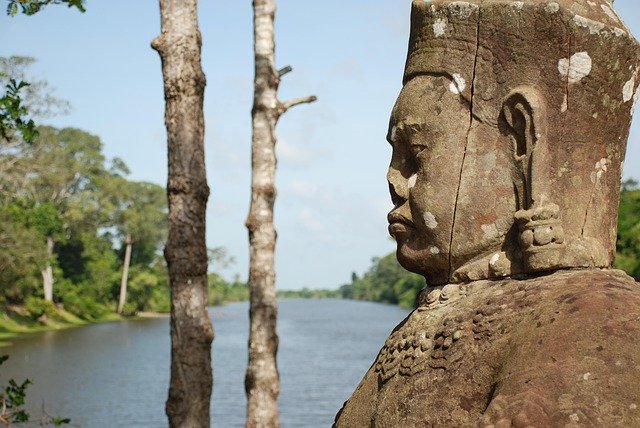
When we think of the Angkor period, we often picture majestic temples like Angkor Wat and Bayon rising out of the jungle. But behind those great stone monuments was a civilization full of life, culture, hard work, and devotion.
So what was daily life like for the people who lived during the Angkorian era (9th to 15th centuries)? How did they build such a powerful empire, and what did their everyday routines look like?
Let’s take a step back in time to explore how people lived in the Angkor period—the golden age of the Khmer Empire.
🏠 1. Homes and Village Life
Most ordinary people didn’t live in temples—they lived in wooden houses built on stilts, often near rivers, rice fields, or reservoirs.
- Houses were made from bamboo, palm leaves, and wood
- Built on stilts to protect from floods, animals, and pests
- Villages were often organized around temples, roads, and water reservoirs (called barays)
These homes have disappeared over time because they were made of perishable materials, unlike the stone temples that remain.
🌾 2. Farming and Food: Life on the Land
The Angkor Empire was powered by rice farming, thanks to its advanced water system.
- Farmers grew rice 2–3 times per year using irrigation canals and reservoirs
- They also grew fruits, sugar palm, vegetables, and medicinal plants
- People raised livestock like buffalo, pigs, chickens, and caught fish from rivers and ponds
👉 Rice was not just food—it was the foundation of the economy and society.
🧱 3. Builders, Artisans, and Workers
The massive temples and cities were built by tens of thousands of skilled workers, including:
- Stone carvers who made beautiful bas-reliefs and statues
- Bricklayers and laborers who built pyramids, galleries, and roads
- Metalworkers and jewelers who created ornaments and tools
- Potters, weavers, and blacksmiths who produced goods for daily use
These workers were often organized under a feudal system, offering labor in exchange for protection, food, or religious merit.
🛕 4. Religion and Spiritual Life
Religion played a central role in every part of life.
- Early Angkor was mostly Hindu, worshipping Vishnu and Shiva
- Later, Buddhism (especially Mahayana and Theravada) became dominant
- People visited temples for festivals, offerings, and community events
- Monks and priests served as teachers, healers, and advisors
Every village likely had a local shrine or temple, even if it wasn’t as grand as Angkor Wat.
🧑🏫 5. Education and Language
Most people were not formally educated, but temples acted as schools, especially for young boys who became monks.
- People learned Khmer, written using the Khmer script (inspired by ancient Indian scripts)
- Religious texts, medical manuals, and royal decrees were carved into stone or written on palm leaves
- Oral traditions, folk stories, and chants were passed down through generations
👑 6. Social Classes and Government
The Angkor society was organized in a strict hierarchy:
| Class | Description |
|---|---|
| 👑 King (Devaraja) | Seen as a god-king, center of the universe |
| 🏛️ Royal Court & Priests | Managed temples, rituals, and government |
| ⚔️ Warriors & Officials | Protected the kingdom and enforced laws |
| 🧱 Craftsmen & Traders | Created goods and moved them across the empire |
| 🌾 Farmers & Laborers | Made up the majority of the population |
The king was both a political and spiritual leader, supported by an elite class and a large working population.
🛣️ 7. Trade and Travel
The Khmer Empire had advanced roads, bridges, and highways that connected Angkor to distant provinces.
- Trade was carried out with India, China, and Southeast Asia
- Items traded: gold, spices, elephants, silk, ceramics, and forest goods
- Markets were lively places where people exchanged goods, ideas, and news
The kingdom’s wealth came not just from farming, but from being a cultural and economic hub in the region.
🎉 8. Festivals, Art, and Entertainment
Life wasn’t just work—people celebrated, danced, and sang too.
- Festivals aligned with agricultural seasons and religious events
- Dancers performed Apsara dances—graceful, sacred movements still performed today
- Music included drums, flutes, gongs, and the roneat (xylophone)
- Storytelling, shadow puppetry, and ceremonies kept culture alive
🔚 Conclusion: Life in the Shadow of Greatness
While Angkor Wat and the temples are monumental, the people who lived in the Angkor period were farmers, builders, artists, priests, and families—ordinary people building an extraordinary civilization.
Their knowledge of water, architecture, religion, and community helped the Khmer Empire become one of the most powerful in Southeast Asia’s history.
Visiting Angkor is not just about seeing stones—it’s about understanding the lives behind the legacy.